

Contact us
Nanwangzhuang Village, Pengdu Township, Binhu New District, Hengshui, Hebei Province

Seismic isolation rubber bearing


- 产品描述
-
Introduction to Seismic Isolation Rubber Bearings
Seismic isolation rubber bearings are rubber bearings used for seismic isolation of buildings, bridges, or other structures in areas with high seismic intensity. Ordinary rubber bearings are products made of multiple layers of rubber sheets and thin steel plates vulcanized and bonded together. They have sufficient vertical stiffness to reliably transmit the reaction force of the upper structure to the foundation structure, good elasticity to accommodate the rotation of the beam ends, and a large shear deformation capacity. However, because they use natural rubber or chloroprene rubber, they do not inherently have significant damping properties. The damping ratio of natural rubber bearings is typically below 0.02~0.03, while that of chloroprene rubber bearings only reaches 0.05~0.07. Therefore, they are usually used with damping mechanisms.
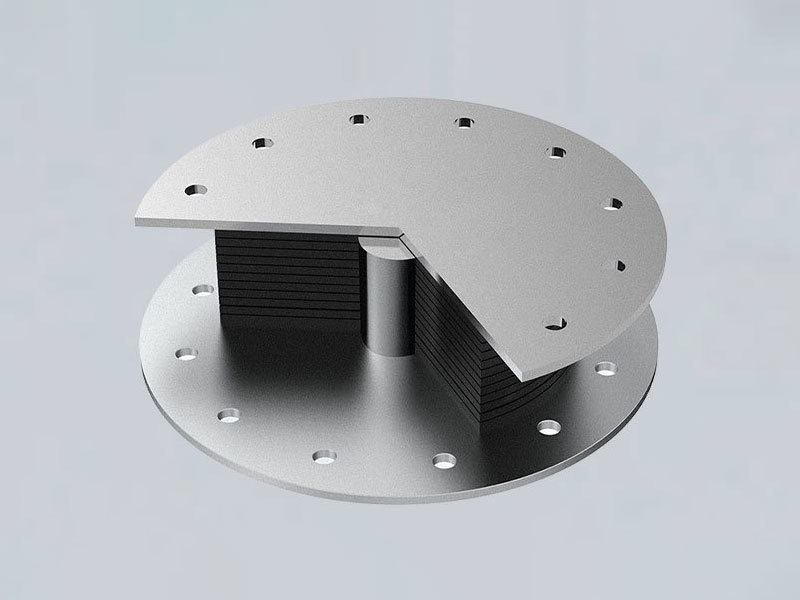
Lead-core rubber bearings (as shown in Figure 1) are formed by vertically pressing a 99.9% pure lead core into the center or around the center of a laminated rubber bearing. Because the damping can be selected by adjusting the diameter or cross-sectional area of the lead core, the design of the bearing has considerable flexibility. Under repeated loading, lead-core rubber bearings maintain good fatigue resistance and excellent durability. The presence of the lead core also increases the initial stiffness of the bearing, which is beneficial for controlling wind response and resisting ground micro-vibrations.
TAG:
Phone
Address
Nanwangzhuang Village, Pengdu Township, Binhu New District, Hengshui, Hebei Province
Leave Message