

Installation and Maintenance of Plate Rubber Bearings
Feb 15,2025
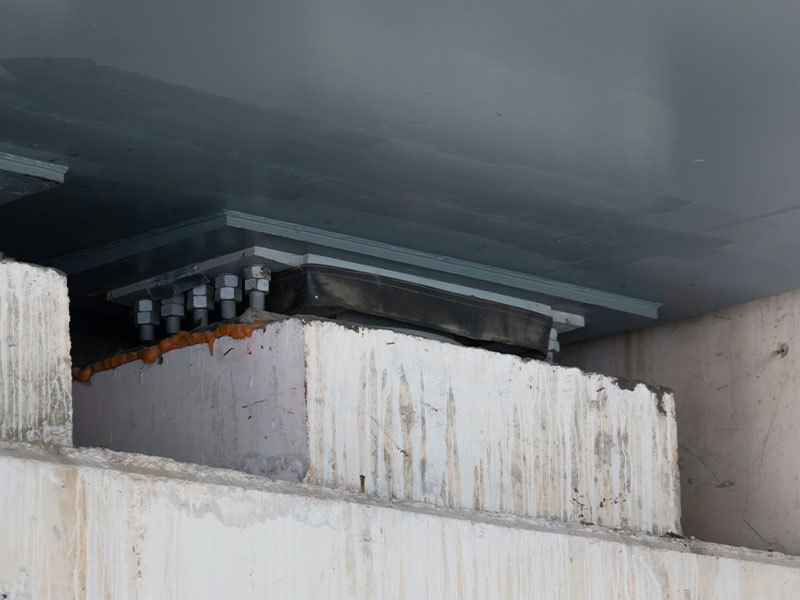
Rubber bearings are located in important positions at the connection points of the upper and lower structures of bridges, and their reliability directly affects the safety and durability of the bridge structure. Therefore, in addition to ensuring that the design and selection of rubber bearings are reasonable and the processing quality meets technical standards, correct construction and installation are the key to the success of rubber bearing application.
Setting of supporting pad stones
In order to ensure the construction quality of rubber bearings and facilitate installation, adjustment, observation, and replacement of bearings, whether using cast-in-place beam method or prefabricated beam method for construction, and regardless of the type of rubber bearings installed; It is necessary to install supporting pad stones on the top of the pier.
(1) The plane size of the supporting pad stone should be able to withstand the load of the upper structure, and generally its length and width should be about 5-10cm larger than that of the rubber bearing. The height of the cushion stone should be greater than 10cm to ensure sufficient space height from the bottom of the beam to the top of the pier for placing the jack (or flat jack). Used for exchanging supports.
(2) Steel mesh should be laid inside the supporting pad stone. When the diameter of the steel bars is 8mm, the spacing should be 50mmx50mm. The vertical steel bars should be connected to the steel bars inside the pier and abutment. The cement grade used for pouring cushion stones should not be lower than C30 grade, and the top surface of the cushion stone concrete should be calibrated with a level ruler in advance, striving for smoothness and non smoothness
(3) The surface of the supporting pad stone should be flat, clean, dry, and free of floating sand, and the top elevation of the supporting pad stone should be accurate and correct. Especially when two supports are placed at one end of a beam, the horizontal error of the top elevation of these two support pad stones must be strictly controlled. The top surfaces of the supporting pad stones for two or four supports of the same beam should be in the same plane, and their relative height difference should not exceed ± 1.5mm; The height difference of the same supporting pad stone should be less than 0.5mm to avoid bias, initial shear, and uneven stress.
TAG:
Phone
Address
Nanwangzhuang Village, Pengdu Township, Binhu New District, Hengshui, Hebei Province
Leave Message